Honest numbers on the risks your teams actually face.
One guided assessment maps the digital and physical risks a team carries — phishing and stolen accounts, theft, violence, medical emergencies, exposure of the people they work with — and puts conservative, defensible figures on them, framed against the risk tolerance your board has declared.
- Built for sending organizations and the field teams they deploy
- Hosted on AWS, managed by us
From Kavanah Security, the risk management and cybersecurity consulting division of Kavanah Media
What it does
Expert judgment and threat intelligence, turned into quantified risk a board can act on and a team leader can use in the field.
A guided assessment
Answer plain-language questions about where a team works and what it does. The assessment assembles a conservative risk model from your answers — nobody has to learn a risk framework first.
Threat-informed
Every digital scenario maps to real techniques from the MITRE ATT&CK knowledge base, curated for how mission teams and their phones are actually targeted, and exports an ATT&CK Navigator layer.
Numbers you can defend
Losses are simulated thousands of times from calibrated three-point estimates, the way financial risk is modeled, and deliberately understated. An alarming number is easy for a board to dismiss; a conservative one holds up.
Framed against your tolerance
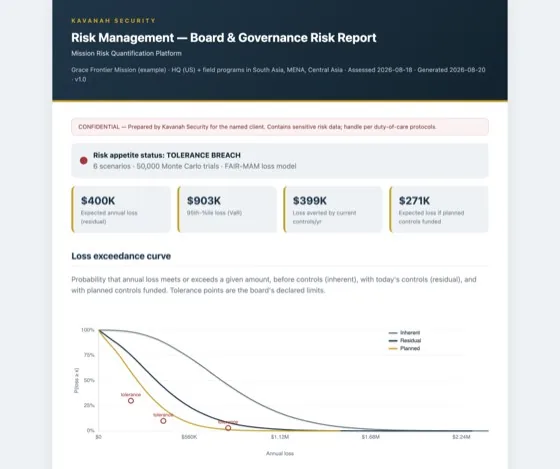
Your board declares its risk appetite — an expected-loss ceiling and a worst-year ceiling. Every result comes back as within, approaching or breach, so the conversation is about your limits, not abstract scores.
Which safeguards matter most
Each control is scored on how well it works, how much it covers and how reliably it stays on, so the report shows which fixes buy the most protection for the least cost — including free protections most organizations already have and only need to switch on.
Two reports from one assessment
A governance summary for leadership — dollars, appetite against tolerance, return on funded fixes — and a field safety brief in plain language with go, caution and stop guidance a team leader can act on with poor connectivity. Both export to PDF.
Country watch
Each team’s dashboard keeps a live watch on the countries where it serves — disaster alerts, travel advisories, health notices and targeted cyber-threat activity from trusted sources, ranked by severity — and emails the team when something changes.
Many teams, one organization
Teams roll up under their sending organization. Each is assessed on its own, then combined into an organization-wide picture checked against the organization’s appetite.
A reporting rhythm
The platform lays out the reporting calendar for you: a monthly pulse, a quarterly board review and an annual re-assessment for organizations, and a lighter, safety-first rhythm for field teams.
Who it’s for
Sending organizations whose boards need a defensible answer to “how exposed are we, and is it within what we agreed to accept?” — and the field teams they deploy to hard places, who need the same assessment translated into what to do this week. Each organization gets its own space, with admin, analyst and viewer roles for its people.
How an assessment runs
From first conversation to a report your board can act on.
Tell us about the team
Where it works, what it does, how it communicates, and what safeguards are already in place. The guided interview turns your answers into a model.
Declare your tolerance
Leadership states the losses it is willing to carry in an expected year and in a bad one. Everything is measured against those limits.
Run the numbers
The scenarios are simulated against today’s controls and against the fixes you are considering, so you see what each one buys.
Report to both audiences
The board gets the governance summary; the team gets the field safety brief. Then the calendar keeps the assessment current.
Questions
Do we need a risk analyst to use it?
No. The guided interview asks plain-language questions and assembles the model from your answers, using conservative defaults. We walk the first assessment through with you.
Where do the threat data come from?
Digital scenarios are mapped to the MITRE ATT&CK knowledge base, using a subset curated for mission teams and the phones and accounts they rely on. Country watch draws on public disaster, travel-advisory, health and cyber-threat sources, which keep growing.
Who can see our assessment?
Only people in your organization’s space, according to the admin, analyst or viewer role you give them. Organizations never see each other. Kavanah staff administer the platform under your duty-of-care protocols.
How do we sign in?
With a work email address and password, with an optional two-factor code. Organizations that run Google Workspace or Microsoft 365 with multi-factor sign-in can also sign in with those accounts once we have set that up for your domain.
Can it run without an internet connection?
The hosted platform is what most organizations use. The assessment engine itself also runs on an ordinary laptop with no network connection, for an analyst working from a locked-down or air-gapped machine — ask us if that is your situation.
What does it cost?
Ask us. Pricing depends on your organization and how many teams you need to assess, and mission organizations can ask about sponsored access.
Want to know where your teams stand?
Tell us about your organization and the places your teams work. We’ll say honestly whether an assessment fits, and set it up if it does.